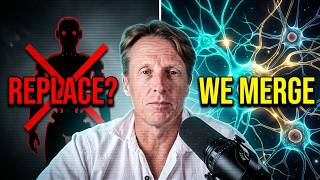
Will AI replace humans? If AI gets smarter than us and can do our jobs, why would it keep us around? I think that question is missing something, and life already answered it once, about 2 billion years ago.
One cell swallowed another, and instead of one wiping out the other, both changed. That merger became mitochondria, and its descendants became every plant, animal and fungus on Earth. It happened again with chloroplasts. Lynn Margulis called it symbiogenesis. In this video I use that pattern to look at artificial intelligence, the future of AI at work, and what it means for you. Why AI replacing humans isn't the whole story, why the middle of every company shrinks first, why a rogue AI is like a tumor that needs a blood supply, and four ways to prove me wrong.
Plus: George Lucas and midi-chlorians, The Matrix, Ghost in the Shell, Terminator, and an answer from Ray Kurzweil's digital avatar.
This is my hypothesis about the future of AI and humanity, not a settled prediction. I'm not saying nobody loses their job, and I'm not saying AI is safe.
CHAPTERS
0:00 Why would AI keep us around?
1:17 2 billion years ago, one cell swallowed another
2:44 Mitochondria: bacteria living inside you
3:32 Star Wars midi-chlorians and Lynn Margulis
4:23 The mitochondrial switch that stops cancer
5:43 It happened again: chloroplasts
7:02 Symbiogenesis: how merging built complex life
9:02 What this means for your job
10:13 The study: AI made support agents 15% more productive
11:34 Steam engines, electric motors and AI
12:58 Redesigning work around a more capable human
14:46 Mouse vs whale: why the middle shrinks first
17:24 Why I think we're merging with AI
19:40 Ray Kurzweil, Metaman and Ghost in the Shell
20:43 Why AI isn't a new species
22:27 Who gets the upgrade?
28:02 Why I'm optimistic about AI
28:49 Four ways to prove me wrong
30:41 So why would AI keep us?
32:37 Ray Kurzweil's digital avatar answers
34:06 Thank you, supporters
SOURCES
Brynjolfsson, Li & Raymond, "Generative AI at Work," Quarterly Journal of Economics (2025)
Lynn Sagan (Margulis), "On the Origin of Mitosing Cells," Journal of Theoretical Biology (1967)
Bar-On, Phillips & Milo, "The biomass distribution on Earth," PNAS (2018)
Judah Folkman, "Tumor Angiogenesis: Therapeutic Implications," NEJM (1971)
Gregory Stock, Metaman (1993)
#AI #ArtificialIntelligence #FutureOfAI
Check out the Our Fractal Universe Books here:
https://www.amazon.com/dp/B0GX465Q68Join this channel for exclusive access:
https://www.youtube.com/channel/UCVNKdkLzWuy1oLuCuCv4NCA/joinSupport the channel and get exclusive content at
https://www.patreon.com/chrislehtoFollow on social
X:
https://x.com/LehtoFilesTikTok:
https://www.tiktok.com/@lehtofilesFacebook:
https://www.facebook.com/profile.php?id=100090658513954Instagram:
https://www.instagram.com/lehto_files/reels/Chris Lehto is a former F-16 pilot with 18 years in the Air Force, a certified crash safety investigator, and the author of Our Fractal Universe. Lehto Files covers UAP research, future tech, alternate physics and the Fractal Universe framework, with a scientific approach and open dialogue.
IMAGE CREDITS (Wikimedia Commons)
Lynn Margulis 2005: Javier Pedreira, CC BY 2.0 | Ray Kurzweil at SXSW 2024: Jay Dixit, CC BY 4.0 | Midichloria mitochondrii in Ixodes ricinus: Uzum et al. 2023, CC BY 4.0 | Ixodes ricinus: W.alter, CC BY-SA 4.0 | Cyanobacteria 40x: Iceclanl, CC BY-SA 3.0 | Living stromatolites, Shark Bay: Landing & Johnson, CC BY 4.0 | Plagiomnium affine chloroplasts: Kristian Peters, CC BY-SA 3.0 | Cytochrome C: Vossman, CC BY-SA 3.0 | Tumor angiogenesis: Mjeltsch, CC BY-SA 4.0 | Doel cooling tower: Trougnouf, CC BY 4.0 | Multicrystalline silicon wafer: Radiotrefoil, CC BY-SA 4.0 | US Supreme Court at dusk: Joe Ravi, CC BY-SA 3.0. Public domain: Darwin 1837 tree, Mereschkowski portrait and 1910 tree, diatoms (G. T. Taylor), Corliss engine, Ipswich machine shop, Tangyes lantern slide, Gray's Anatomy liver, NCI cancer cell, Trinity test, CIA seal. Mandelbrot animation: Math's Town.
Chris Lehto is a former F-16 pilot with 18 years of experience in the Air Force. He managed multi-million dollar simulator contracts, was an Electronic Attack SME for the Aggressors (OPFOR), and commanded the US Detachment at TLP for NATO Fighter Pilot Training. Chris fought in Iraq for 5 months in 2006. He spent 3 years in Turkey as an exchange pilot and is fluent in Turkish. Chris is also a certified crash safety investigator, having investigated Air Force accidents for four years. Lehto has a Bachelor of Science in Chemistry-Materials Science from the Air Force Academy and a Master's in Aeronautical Science from Embry-Riddle University. He was stationed in various locations worldwide, including South Korea, Italy, Alaska, Turkey, and Spain.





 Sign in to UFO Slice

